



Life of Babasaheb Ambedkar
₹ 00.00/- FREE
Life of Babasaheb Ambedkar
by C. Gautam
Published by Ambedkar Memorial Trust, London Milan House, 8 Kingsland Road, London E2 8DA Second Edition, May 2000
Preface
The importance that Dr. B.R. Ambedkar had in the shaping of modern India should not be forgotten. He led millions of the oppressed to a life of self-respect, dignity, and responsibility. Babasaheb always stressed the importance of better education, so that our position in society can be uplifted. It was he who was primarily responsible for the Constitution, adopted after India became independent. Babasaheb began the revival of Buddhism in India that has grown tremendously after his death, and continues to grow today among his countless followers.
This book briefly outlines the history of his life, showing how he overcame all the difficulties facing the oppressed in India, to become one of the greatest men of modern times.
C. Gautam General Secretary Ambedkar Memorial Trust, London May 2000
His Birth and Greatness Foretold
On April 14th, 1891 a son was born to Bhimabai and Ramji Ambadvekar. His father Ramji was an army officer stationed at Mhow in Madhya Pradesh – he had risen to the highest rank an Indian was allowed to hold at that time under British rule. His mother decided to call her son Bhim. Before the birth, Ramji’s uncle, who was a man living the religious life of a sanyasi, foretold that this son would achieve worldwide fame. His parents already had many children. Despite that, they resolved to make every effort to give him a good education.
Early Life and First School
Two years later, Ramji retired from the army, and the family moved to Dapoli in the Ratnagiri district of Maharashtra, from where they came originally. Bhim was enrolled at school when he was five years old. The whole family had to struggle to live on the small army pension Ramji received.
When some friends found Ramji a job at Satara, things seemed to be looking up for the family, and they moved again. Soon after, however, tragedy struck. Bhimabhai, who had been ill, died. Bhim’s aunt Mira, though she herself was not in good health, took over the care of the children. Ramji read stories from the epics Mahabharata and Ramayana to his children, and sang devotional songs to them. In this way, home life was still happy for Bhim, his brothers and sisters. He never forgot the influence of his father. It taught him about the rich cultural tradition shared by all Indians.
The Shock of Prejudice – Casteism
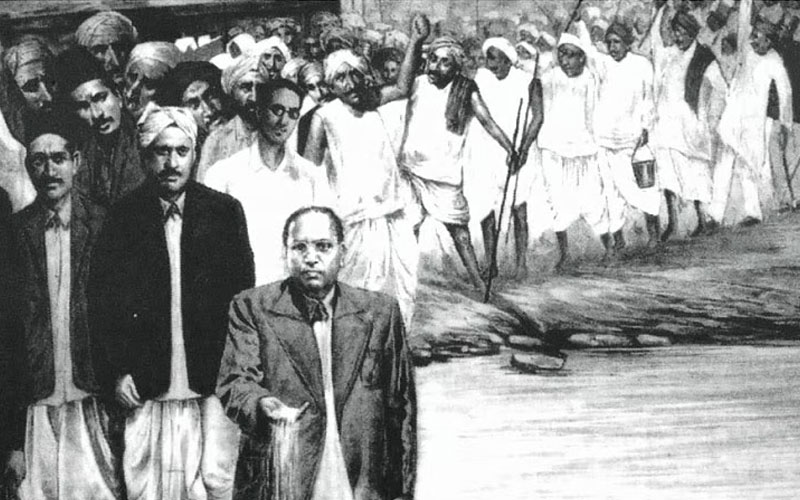
Bhim began to notice that he and his family were treated differently. At high school he had to sit in the corner of the room on a rough mat, away from the desks of the other pupils. At break-time, he was not allowed to drink water using the cups his fellow school children used. He had to hold his cupped hands out to have water poured into them by the school caretaker. Bhim did not know why he should be treated differently – what was wrong with him?
Once, he and his elder brother had to travel to Goregaon, where their father worked as a cashier, to spend their summer holidays. They got off the train and waited for a long time at the station, but Ramji did not arrive to meet them. The station master seemed kind, and asked them who they were and where they were going. The boys were very well-dressed, clean, and polite. Bhim, without thinking, told him they were Mahars (a group classed as ‘untouchables’). The station master was stunned – his face changed its kindly expression and he went away.