



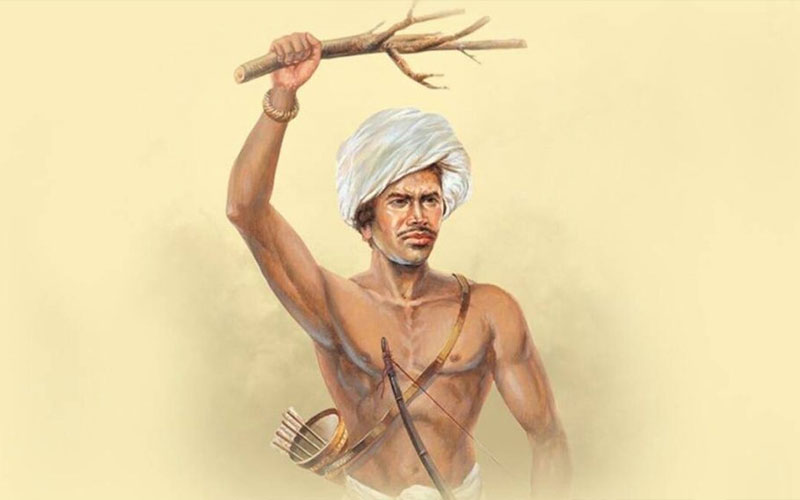
Birsa Munda
₹ 00.00/- FREE
Birsa Munda (1875–1900) was a tribal leader and a folk hero, belonging to the Munda tribe who was behind the Millenarian movement that rose in the tribal belt of modern day Bihar, and Jharkhand during the British Raj, in the late 19th century making him an important figure in the history of the Indian independence movement.
Birsa Munda is named with great respect as one of the freedom fighters in the Indian struggle for independence against British colonialism. His achievements in the freedom struggle became even greater considering he accomplished this before his 25th year.
Birsa’s devotion to his people was such that he was almost revered as God by his followers. By the time he was in his 20s, his activities in the tribal areas of Jharkhand state (earlier Bihar) had already begun to worry the British establishment to a considerable extent. He was finally caught by the British on 3 February 1900 when he was only 25 years old. He died soon afterwards under mysterious circumstances on 9 June 1900 in Ranchi Jail.
Early childhood
Birsa Munda was born on 15 November in the year 1875 on a Thursday, and he was named after the day of his birth according to the then prevalent Munda custom. The folk songs reflect popular confusion and refer to both Ulihatu and Chalkad as his birth-place. Ulihatu was the birth-place of Sugana Munda, father of Birsa. The claim of Ulihatu rests on Birsa’s elder brother Komta Munda living in the village and on his house which still exists albeit in a dilapidated condition.
Birsa’s father, mother Karmi Hatu,[1] and younger brother, Pasna Munda, left Ulihatu and proceeded to Kurumbda near Birbanki in search of employment as labourers or crop-sharers (sajhadar) or ryots. At Kurmbda Birsa’s elder brother, Komta, and his sister, Daskir, were born . From there the family moved to Bamba where Birsa’s elder sister Champa was born followed by himself.
Soon after Birsa’s birth, his family left Bamba. A quarrel between the Mundas and their ryots in which his father was involved as a witness was the immediate reason for proceeding to Chalkad, Sugana’s mother’s village, where they were granted refuge by Bir Singh , the Munda of the village. Birsa’s birth ceremony was performed at Chalkad.
After childhood
Birsa Munda had a very nice and joyful childhood. He was a boy living with Britishers. Birsa’s early years were spent with his parents at Chalkad. His early life could not have been very different from that of an average Munda child. Folklore refers to his rolling and playing in sand and dust with his friends, and his growing up strong and handsome in looks; he grazed sheep in the forest of Bohonda. When he grew up, he shared an interest in playing the flute, in which he became adept, and so movingly did he play that all living beings came out to listen to him. He went round with the tuila, the one-stringed instrument made from the pumpkin, in the hand and the flute strung to his waist. Exciting moments of his childhood were spent on the akhara (the village dancing ground). One of his ideal contemporaries and who went out with him, however, heard him speak of strange things.
Driven by poverty Birsa was taken to Ayubhatu, his maternal uncle’s village. Komta Munda, his eldest brother, who was ten years of age, went to Kundi Bartoli, entered the service of a Munda, married and lived there for eight years, and then joined his father and younger brother at Chalkad. At Ayubhatu Birsa lived for two years. He went to school at Salga, run by one Jaipal Nag. He accompanied his mother’s younger sister, Joni, who was fond of him, when she was married, to Khatanga, her new home. He came in contact with a pracharak who visited a few families in the village which had been converted to Christianity and attacked the old Munda order.
He remained so preoccupied with himself or his studies that he left the sheep and goat in his charge to graze in the fields covered with crops to the dismay of their owners. He was found no good for the job and was beaten by the owner of field. He left the village and went to his brother at Kundi Bartoli, and stayed with him for some time. From there he probably went to the German mission at Burju where he passed the lower primary examination.He also studied at Chaibasa at Gossner Evangelical Lutheran Mission school run by German missionaries. It was here where he was transformed into a fighter for tribals. A Father at the school was narrating the children about the Kingdom of Heaven. The young Daud Purty(baptised name of Birsa) questioned the Father where was this Kingdom of Heaven when there was so much exploitation of tribals by zamindars and landlords in their own homeland.